Abeer N. Kashmeeri
Historical Women's Fiction Author from Saudi Arabia

Step through the door first
be the first to know when The Rosewater Bookstore opens
Join my mailing list for cover reveals, the release date, and a free gift — Fatma's Kitchen: Recipes from 1970s Madinah. I won't crowd your inbox; I'll only write when there's something worth sharing.
From the Journal Nook
Notes on heritage, history & the writing life
The Boy Who Said “No”
It wasn’t like any other class I taught. This was the misfits, the talk-backers, the I-am-only-here-to-make-your-life-hell sort of class. It was my second teaching job, so I figured I had earned a couple of medals in perseverance and patience. These twelfth graders made me want to throw those imaginary medals out the window. They made me question why I chose this profession. I overprepared for that class and failed more often than I cared to admit. And so, with that same defeatist hope, I overprepared again.
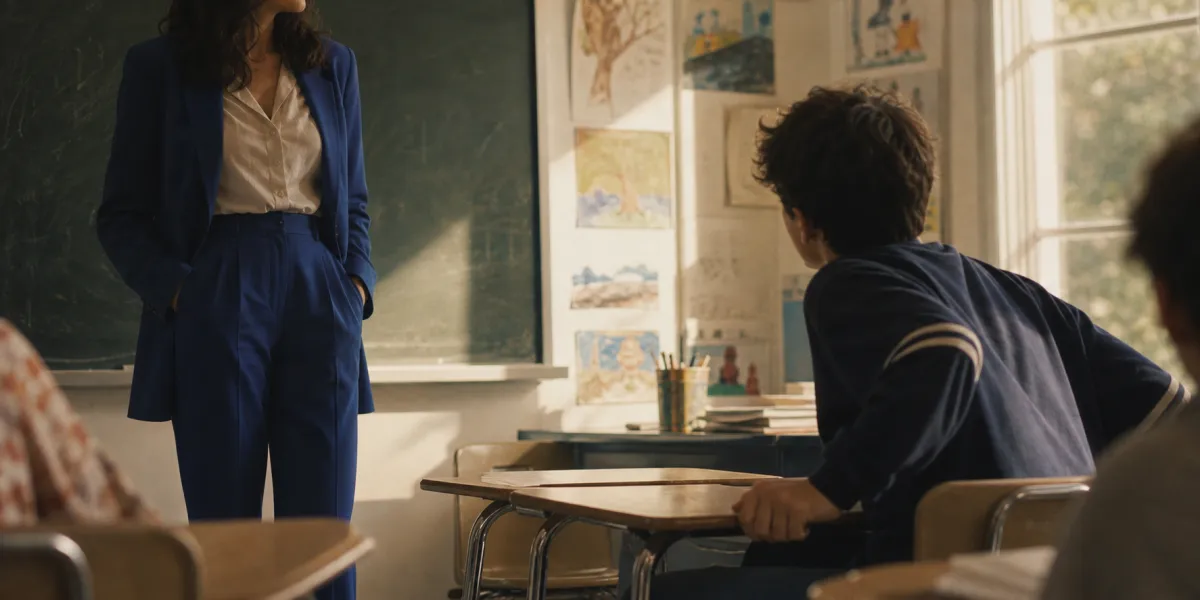
To shake things up, I prepared fifty titles: jobs, places, sports, animals. I asked my ten students to each choose one and speak about it for five minutes at the front of the class. I wanted them to gain confidence, to learn how to improvise. My shoes pinched as I walked in, and I wiggled my feet inside them at the door. The pantsuit was one of four I rotated through the week with different blouses. That day I wore the power blue, and I had picked the shoes to match it. I adjusted the collar as if I were waiting for a jury’s sentence, held my head high, and pretended I was not fazed at all.
The classroom smelled. It hit me like a slap every time, a jailhouse welcome. Cheap perfume and boys’ sweat made a lethal mix. I cleared my throat and took my notes from the worn-out bag, setting them on the desk while the boys and girls traded grunts and burps and laughed, high-pitched, at any and everything. My heels had seen better days in these halls. When the class ignored me, I taped the four pages to the board and turned to face them. Now they were curious.
“What is that, Miss?” the girls asked first.
“Yeah, what the hell is that?” the boys echoed.
I swallowed and used my authoritative voice, the low and soft-spoken one.
“This is your assignment today.”
“Miss, can’t you give us a day off?” the boys in the back shouted. It set off a chorus of pleas. I shifted from one foot to the other, trying to collect my thoughts. My shoes hurt more when I moved.
“I need you to calm down and listen carefully.” My voice nearly cracked but made it through.
My low, quiet delivery seemed to promise consequences. Those few Zoom voice workshops had been worth it.
They settled into the beige desks, chairs scraping until one of my eyes squinted shut at the sound. The walls held student artwork. This month it was mosaics, and the good ones probably belonged to the front row. I rounded the desk slowly, easing the pinch in my shoe, and leaned a hand on it to take the weight off.
“Let’s begin. First row starts, then the row behind them.”
Ten students, two rows of five.
Everyone did well except the last student, a boy from South Africa. He had thick, coarse hair and light brown eyes he kept half-closed, not from boredom but to scan the room without anyone clocking it. Those eyes opened wide and fixed on mine. He talked back to teachers. He had been expelled twice already, once for cheating, once for humiliating the PT teacher. When he wasn’t in fight mode, he was easy with the other students, and with the teachers he liked.
I was not one of them.
I gave too much homework, he would say, loud enough for me to hear. On homework days he tossed his paper onto my desk.
He locked eyes with me and said,
“I am not doing this stupid exercise!”
The stupid stung. The I-am-not-doing-this was the real challenge, and I held his stare.
The class leaned into the showdown. This face-off had better break my way, or I would lose the whole room. If he backed down, he would lose face in front of his peers. His stake ran higher than mine. He was fighting for who he wanted to be. I was only fighting to teach a lesson.
He sat halfway off the chair as if it were a chaise longue. All he needed was a cocktail in his hand and a beach somewhere.
His eyes never left mine, daring me to force the exercise, almost begging for the duel in front of everyone. He held the longer sword, backed by students who wanted someone, anyone, to tell these teachers to leave them alone. A triumphant squeal here and there from the girls, huffs and puffs from the boys. He was nervous, though. The louder they got, the tighter he pressed his lips.
I had been a student like him once. The head of department back then was patient with me, gave me room to grow and still nudged me forward. I came up in the ’80s and had my share of prejudiced teachers. One of them caught me misspelling forbidden and went on a rant.
“I am very protective of the English language and do not accept mistakes like these!”
The other students surely misspelled words too and went unreprimanded. That was the moment I decided to teach, to reach the ones who needed it inside school and out. This was one of those moments.
I walked to his desk. He blinked a touch too fast and pressed his lips against whatever he had meant to say. The arm on the chair drew in toward his body. He had bitten off more than he could chew. I cocked my head to the side so this would not read as a head-on collision. The bravado was all shield, and there was not much left behind it. I said,
“Okay, that’s fine. But what if I told you that if you pick a topic and talk about it for five minutes, I will give you an A on your next quiz, regardless of your answers?”
His body eased, and he propped himself up with the air of someone who had just won the war. He looked at me sideways, like he did not believe me.
“Yes, I will give you an A,” I repeated, loud and clear.
He glanced around, and I smiled, because He glanced around, and I smiled, because I had found a way for us both to walk out of this, even if the lesson did not. He stood, fumbling a little, and scanned his classmates for some sign that they still saw him the way he wanted to be seen. He picked a subject and mumbled at first, until I cut in, speaking to the frightened boy inside him. I shuffle the pages on the desk although it did not need it.
“You’ve got this,” I said from my seat, slipping off my shoes and letting my feet breathe at last.
He cleared his throat, met my eyes for a second, and spoke in front of his peers with a confidence I had not seen in him. He had a voice after all.
1999


Historical women's fiction from the heart of Saudi Arabia — stories of resilience, heritage, and the quiet brilliance of women.
explore
Legal


© Copyright 2026. Abeer N. Kashmeeri. All Rights Reserved.