What The Chateaux Could Not Teach
Written in March of 2021
Château Mont-Choisi taught me to stand up for what I believed in, and how to French kiss.
Arriving from Saudi Arabia at this all-girls finishing school, alone for the first time in my life, I inspected the place like a detective in the body of a refugee. My hands were sweaty, but my throat was as dry as the desert I had come from.
My first glimpse of Château Mont-Choisi was through a bus window. As I stared, I took in a breath of new beginnings, like a whiff from a botanical garden. From inside the bus, I could already tell that my long, pink, conservative dress was out of place. The girls walking outside wore blue jeans and lovely cardigans, their necks wrapped in scarves. They were dispersed along the entrance, waiting to check out the new arrivals.
I stepped out of the bus with false bravado. I had one bag in tow, which I would later discard because my schoolmates would teach me how to dress “cool.” As my sensible brown shoes hit the gravel that decorated the entrance, reflecting a glow from the sun, I might as well have been walking on the moon. I had never seen gravel before. Steadying my steps, I looked up. It was like I’d entered a new dimension.
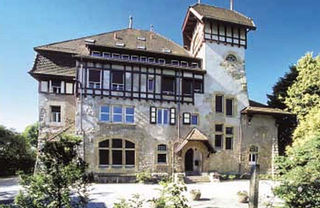
The castle loomed majestically above me, with architecture I did not understand back then but admired. At thirteen years old, I had never seen a castle before. I savored it all, my eyes reflecting the green of the trees, the blue of the skies, and the snowy backdrop of the mountains.
The stone walls were freshly scrubbed and gave off a sheen. The lower half of the castle was white stone, but its upper half was dominated by wood framing, like a bear protecting its cubs. I stood gaping, frozen with delight. This was another world for me. I was used to all girls back home, but having to live with them was new, exciting and scary all at the same time.
Despite its grand appearance, the castle was relatively small, with only four floors in the main building for dorm rooms. For the first year, I was placed on the third floor, next to the principal’s room. Later, I was told that Madame Veerse would place new students near her for observation.
The girls, aged thirteen to sixteen, came from all over the world: Central and South America, France, Italy, Iran, and Asia. We may have come from different cultures, but we were all the same, looking for a home to unpack our turbulent emotions when dropped off by our respective dysfunctional families. Our similarities were strong, cemented in our disorientation when we first arrived and our search for a new kind of family.
I settled into my room, unpacked my old life, and looked forward to packing everything new. Armed with my wits, which suddenly appeared on tip-toe for survival, I assimilated into the pool of global students. Cautiously, I introduced myself to the Middle Eastern girls, Nisreen from Kuwait, and Nora from Saudi, like me. They welcomed me with open arms, filling me in on outing days and punishment days, and how boring it was that only women taught our academic classes. They took me by the hand to receive our books and stationery distributed at the start of each semester: French, Math, English, and History.
The first few weeks were the hardest for me as I missed my family terribly. Homesickness ate away at me like an illness. I started praying the five Islamic prayers daily, asking Allah to take me back to what was familiar and safe. Sleeping with a roommate and adjusting to waking up at 7:00 a.m. with a loud bell and then hurrying to shower before other girls filled the stalls, was exhausting. I longed for my mother’s sweet voice as she rubbed my back and kissed me on my forehead, promising me a big breakfast.
Breakfast was served in the dining hall at 7:30. I did not complain about the food because it was top-notch. All the meals were immaculately prepared and scrumptious. When finished, we would all hurry to our classes with our books in our hands, ready to learn about the world.
Our Etiquette class was popular and among our favorite subjects. We learned where to place utensils, how to cut meat without resting our elbows on the table, and never to talk while we chewed, but the class could not teach us how to keep our tears at bay when we missed our parents.
Privacy was a thing of the past. Friends of my Italian roommate, Graziella, would barge in, shouting Ciao and sitting on my bed. I was still shy and did not know how to handle so many people all at once. I sat on the corner of my bed pretending to read, not understanding what they said as it was all in Italian. I envied how comfortable they were in their own skin. They laughed loudly and spoke even louder. Where I came from, a woman’s voice should be soft and gentle. They wore sans bretelle (sleeveless tops) and tight jeans, and their hair surrounded their face like a beautiful frame. I wore a headscarf back home. Graziella, my roommate, had curly, brown shoulder-length hair. She was tall and liked to wear short skirts. We didn’t speak much as her English was weak. Most of the time, I learned to conceal my feelings and hold my pain inside, all while laughing the days away until we went home for Christmas.
As the days passed and I got to the point where I hated one teacher and loved another and had best friends and not-so-best friends, I felt more at ease. I would exchange notes in class with a Japanese girl, Nobuko, who later became my closest friend. We would send love notes to each other, as only thirteen-year-olds could, with hearts and cats drawn on them.
By the time I’d lived a few Tuesdays at Mont-Choisi, I had learned that this day was sacred. Parents called on Tuesdays, and we were also allowed to make phone calls. Younger girls were homesick and cried on the phone, their sobs and tears flowing like avalanches; we knew they were inconsolable and left them alone. Other times, when girls cried the normal tears of missing their parents, we cried with them.
On those depressing Tuesdays, we all waited in line for the much-anticipated call in which parents told us everything would be okay. How are you doing? How are you getting along with the other students? How are you adjusting to the foreign, new land? Most importantly, we waited for the magic words that replaced much-needed hugs: we love you. Nobuko and I would scout and comfort the friends most affected by missed calls. We would hug them and bribe them with sweets we had stashed from our weekend outings.
One Tuesday my own name went uncalled. I stood by the hall phone as the line shrank ahead of me, certain my turn would come. It did not. A girl behind me touched my shoulder and I shrugged her off. I told everyone the line to Riyadh must be down. That night Nobuko and I built a story where my parents had only lost track of the day, and I let myself believe it.
While Tuesdays were sad for the younger girls, for the older girls who had boyfriends, Tuesdays were golden. They would hold the phone close to their mouths, giving the other girls in line their back as they whispered sweet nothings to the boy. We all knew that ignoring their love words and talking among ourselves was the decent thing to do, to give them privacy. After the phone calls, though, we would press them for details of the call in hearts and spades. I especially held onto their tales of love. My country had no “boyfriends,” only arranged marriages. I had never heard any love story firsthand. It was always the same story: he came and proposed, and she accepted, and they lived happily ever after. There were no divorces and plenty of child-bearing. These young love stories were new to me, and I loved hearing them.
At the end of the call day, many of us would gather in the respective rooms of our closest friends and try to come up with scenarios to explain why some calls were not answered by parents.
“Why do you think Nisreen’s parents missed the call this week?” Nobuko would ask one week. Every week, the same question was asked with variations of the names of different friends. Our answers varied. Maybe there were verbal fights, maybe parents were finalizing a divorce, and someone always threw in physical battles between them as a reason. We constructed scenarios that girls our age should never have to.
As it turned out, we were all there for more or less the same reason: our families were in crisis. Divorce was in the cards for many of them. Our parents’ strategy of dropping us off at a finishing school to make themselves feel better ultimately took away our innocence. It taught us stoic behavior and to bury our anger. We dismissed them as spinsters. Those who can’t marry, teach, we told one another, as if it were proven. Where most of us came from, a woman who passed a certain age unmarried was discussed in lowered voices, as though she had failed somehow. Those teachers were such women, an example of that failure. They could not teach us anything about love, we decided. We were furious at our own mothers and had no pity for women who had never become anyone’s mother, yet we never once realized that our own mothers feared that same fate for us.
We had good moments, too, when we gathered at night, sneaking from our room to the one with the Ouija board. We imagined spirits around us that told us our fortunes. We also discovered that some girls purposely moved their hands from letter to letter to scare us. It was all in good fun, though. We muffled our screams, laughed at one another, and hugged tight at the sight of an illusionary shadow. We learned that being afraid of ghosts together, united, helped us to overcome that untamed fear of being alone in a faraway land. On those nights before lights out, we would plan where we would go on Saturday.
The weekends were just as important as Tuesdays. School rules allowed a four-hour outing window on Saturday and Sunday afternoons. We all looked forward to leaving the prison of the castle walls. We were each given fifty Swiss francs a week. Even if parents could give more, the school would equalize our pocket money for fear of envy or social distinction. As we dressed up to go to Pizza Mario, our favorite hang-out, or Pass-Par-Tout, a more music-oriented café, our excitement knew no bounds. We had to sign going out and sign coming in.
The first time I entered the café, it was full of young men who looked scarily handsome and sophisticated to me. I was paralyzed with self-consciousness, unable to move my mouth to chew my gum, as if the movement of my mouth would show how very terrified I was. I spit the gum on a tissue immediately. I closed my mouth and put on a brave face, as if I always went to these mixed-sex places. It was exhausting at first, but I slowly started to feel more confident until eventually I chewed gum effortlessly.
That confidence got me in trouble. Madame Brigit caught me chewing gum during her lesson and made me spit it into her open palm in front of the class. I kept my chin up while I did it, which cost me Saturday outings. She was the German teacher, and she had it in for me, calling on everything I did and pointing out my mistakes, unlike my French teacher, Madame Christine, who always offered me comforting advice when I reached out to her about my friends, homework, or even my parents’ strictness about boyfriends. She was indeed a great teacher. My French is still good today, even though I have not practiced it in years.
Every week, we agonized as we waited for the reveal of that week’s punishment manifesto, even taking bets on who was in trouble and would have to remain in the castle. Staying in for the weekend was seen as a fate worse than death by many of us.
The dining room was light blue, with big windows that let in the light. On Saturdays, it seemed foreboding and vast as we waited for the punishment roll call. Cries filled the room as names were announced one by one, very deliberately. The principal had the honor of naming the girls. Mine was called out almost every weekend. Who would have thought the demure girl from Saudi Arabia had a rebellious streak in her? I learned that chewing gum or finding my voice to state my opinions could sometimes be tagged with a heavy price.
The identity of the teacher who gave the punishment was never revealed, but I knew my executioner was none other than Madame Brigit. She even punished me on the weekend of my birthday. I cried and begged her to push it to the weekend after, but she would not budge. All my friends hated her as much as I did that week.
Those of us who were grounded waved goodbye to the lucky girls stepping outside the castle walls, having already asked them to buy us sweets. They stuck their tongues out at us in tormenting fashion as they left. And we learned to live with the consequences of our choices.
In the second semester, two devils arrived at school from Japan. They were blond American sisters who wore jewelry around their wrists and necks. Jacklyn and Joan were the worst-behaved girls in the school by far. One night before bedtime, they peed in a bottle and pretended it was iced tea, enticing the girls they didn’t like to drink from it. By then, I had gotten better at making friends and was among the first to befriend them.
“Come on, you pussy!” they said to me. “Hand the bottle to the first girl who comes in, and say it’s iced tea.”
I stood before these strong, frightening girls and tried to muster some courage. I was mortified at their request. Those were my friends they wanted to trick. They’d chosen me to do their dirty work because their targets would trust me. Once I understood what they were asking, I refused.
“Chicken, hand me that bottle. We will do it.”
My friend Nora, the first victim, walked in with a big smile. They gave her the bottle.
“Here, take a sip; we made iced tea,” Jacky said with a mischievous smile that I understood all too well.
Before Nora could take it, I yelled, “Don’t! It’s pee!” I snatched it so quickly that some pee spilled on their bedroom floor.
“You stupid idiot,” Joan said, giving me a stink-eye as if I had murdered her mother.
The next day, I avoided the American sisters entirely and stayed in class and the recreation room all day. When I entered my room, Graziella was sitting cross-armed on her bed.
“What?” I asked.
She only pointed toward the window, pity on her face. I walked across the room with trepidation, doom already gathering in the pit of my stomach. I leaned out and looked down. My clothes were strewn on the gravel. The two devils had thrown them from the third-floor bedroom window. At that moment, I knew I’d paid a price for standing up to them. Evidently, their parents’ divorce had damaged them almost irreparably.
I had my first cigarette, with trembling hands, after being bullied by those two sisters. As my friends helped me pick up my strewn clothes, they decided to cheer me up by inviting me to try smoking. I’d had my fill of saying no that day and was too shaken to stand up against anything. With an inhale that set my lungs on fire, I had my first puff of nicotine. Coughing and sputtering, I might have just escaped a burning building.
As we smoked, we planned our revenge, each chipping in with ideas. We settled on going through their clothes and ruining some of their outfits. With a creative director as a father and a fashion model as a mother, the sisters had impeccable taste in clothing. In the end, the two sisters were expelled after that prank, as they called it, and left with ruined outfits. The rest of us went back to being ‘normal’ misfits.
My first taste of wine was between cigarette drags in our second-floor bathroom, away from the principal’s floor, celebrating our victory over the bullies. My two roommates, Graziella and Teresa, an American, fanned the smoke vigorously in the direction of the window. We vied with one another to gulp the most from the bottle to get a buzz. The wine smelled pungently of rancid vinegar, but we didn’t care; we were experimenting as girls our age should. When we finished the bottle, we laughed so hard that red spit came out of our mouths and nose. The drinking only resulted, of course, in all of us bending over the toilet seat in turn while our stomachs rejected the alcohol that had flooded our virgin bodies. Afterward, we sat on the bathroom floor, our butts freezing on the cold tile, and fell asleep on one another’s shoulders, slurring words of love.
We never did anything halfway; we went all out when breaking the rules. Girls who did not have permission from their parents to smoke would take drags from our cigarettes in the recreation room. We drank in the bathroom when we could sneak a bottle in from our weekend outings. We snuck into one another’s rooms after hours. And then there were the heavy players, the older, bolder girls who had been there for over three years, who would sneak out of the school grounds at night, as rumor had it. We never knew if it was true, or if the older girls just wanted to give themselves some clout. It didn’t matter, we were in awe. I could never be so daring.
The most daring I became was when I experimented with French kissing. I had my first kiss with a girl against the backdrop of another girl throwing up the wine that had given us the courage to learn to kiss. We tried different ways, asking if it felt right. Tongue in, tongue out, suck upper lip, suck lower lip, tilt head. We laughed and spat wine in each other’s mouths. It was gross, but also wonderful. Satisfied, and thinking we were experts by now at how to give the best French kiss, we planned our outfits for the school’s mid-semester dance at Christmas. I wobbled out of that bathroom drunk on experience.
We all looked forward to attending the ‘ball dance,’ as they were called. I was more excited than anyone as I had never been to a mixed ball or danced with a boy before; I don’t think I could even have imagined it. The night before the dance, I could not sleep until 4 a.m. I would imagine the music and the look the boys would give me in the dress I had bought. Most importantly, I wondered if I would be gifted a boyfriend, and the chance to demonstrate my expert French kissing. I went searching for rainbows with butterflies in my stomach.
The Christmas ball held no such gift for me, but the next year, I had my first boyfriend, a French-Swiss nineteen-year-old named Jeff. He would send me flowers and poems in beautiful stationery. The night-shift teacher would call my name, and I would run down three flights of stairs, skipping two stairs at a time, beaming with delight. All the girls would ooh and ahh their way to the bouquet, smelling it and giving me the thumbs up. That was my introduction to love with a boyfriend, which was very different from my first introduction to the rules of courtship by my parents. I clung to that kaleidoscopic vision of love. Hungry for it, I plunged headfirst, like a starving girl toward a lavish feast, ignoring all warning signs.
A couple of months into our “relationship” I had my first real kiss. I tried to remember everything we girls had taught one another, but nothing prepared me for how wobbly my knees would feel and how his mint-tasty tongue would hold my lips hostage. A few months later, I had my first heartbreak. Jeff apparently was sending flowers to another girl from a different school. And that is how I learned that love also comes with the risk of betrayal.
As time passed, teachers warmed up to us, as we did to them, and our friendships grew stronger than the stones of the castle. We began to understand that our families had sent us to boarding school under the pretense that it was for our good rather than admitting their fear of us witnessing their ugly marriage wars. We should not have blamed ourselves for their miserable lives, but we did.
In those two years, I learned not to discriminate because we were all one another’s friends and confidants. Everyone’s different background brought something to the circle. We all knew one another’s love lives and dysfunctional families. We were generous with our life advice, which was lousy but very heartfelt.
Upon leaving Château Mont-Choisi, I cried tears of loss. My newfound friends had become family. I had come craving unconditional love, and had found it in bucketfuls with these girls. I promised to write to them, and they promised the same. But as life would have it, we all returned to our respective countries, fearing the unknown. Back then, keeping in touch across the globe was challenging, so, against our wishes, we slowly slipped from one another’s lives.
To my surprise, I heard that a couple of our teachers went on to get married. They were supposed to be spinsters! If I could turn back time, I would thank those teachers who dealt so well with dozens of hormonally-charged girls who’d been discarded by their parents and were full of fury and fear. They had a hard job, and we did nothing to make it easy.
The Château closed as a school in 1995. I went back in 2015 to meet my Japanese friend, Nobuko, whom I found on Facebook, and learned she eventually settled back in Geneva, Switzerland. As I walked on those gravel paths with my best friend, she hugged a tree, and I swept my hand slowly over the wooden window frame of the room where we used to sign ourselves in and out. The wood rested tightly within its white stone setting, contrasting what is set in stone with what can be burned, almost like the lessons we learned. Château Mont-Choisi taught us that true friendship is set in stone, whereas we came to see that the agony of our parents’ lives, which shaped our understanding of marriage, was flammable.
Gone are the shouts of the teachers and the laughter of silly girls on the long gravel passage. But some things remain. Teachers are invaluable, and good friends become family. Freedom is a choice.